Spyroidea
Radiolaria System
Public Space
Granada Botanical Garden, Spain
Project Overview
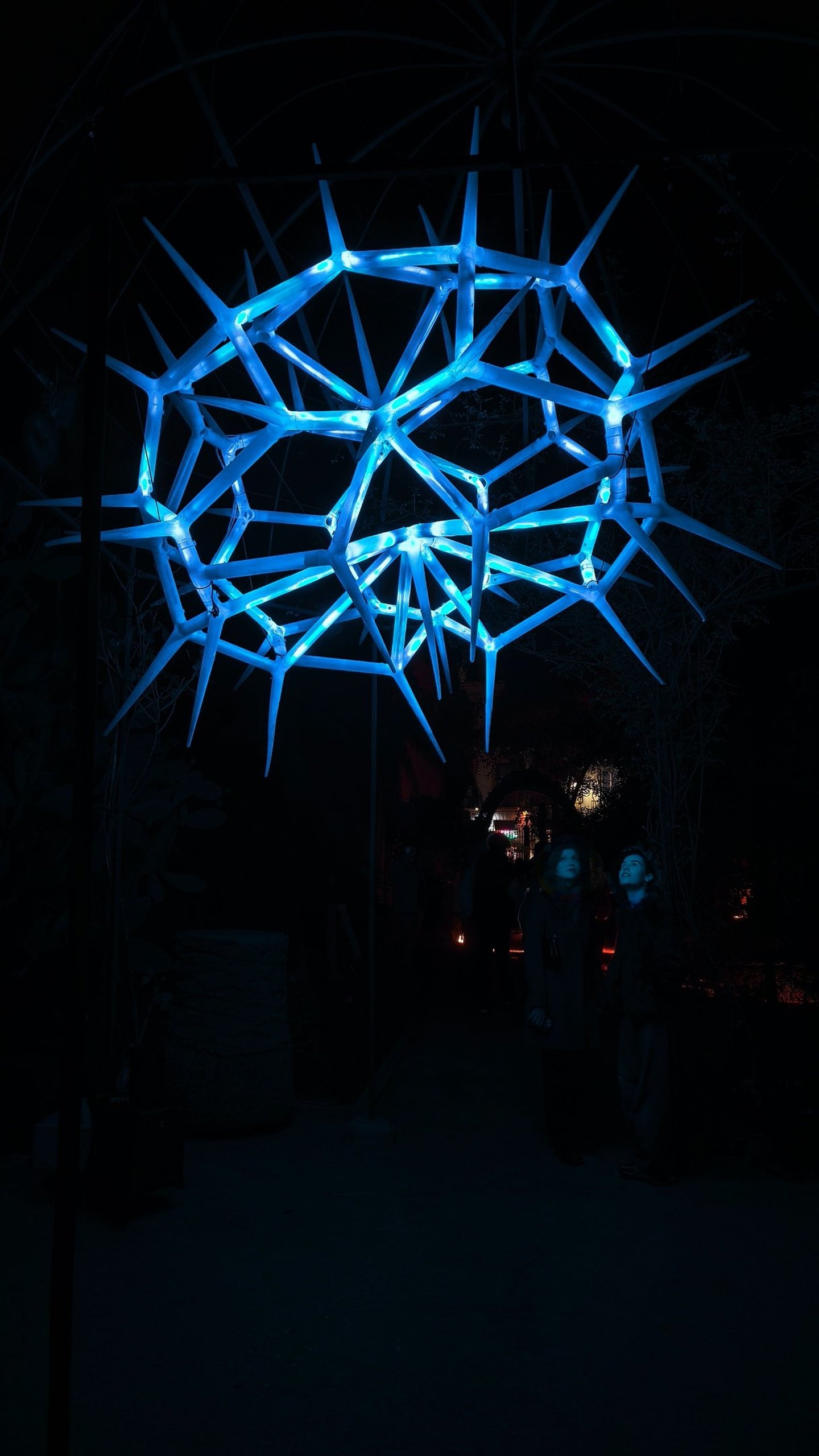
Radiolaria is a suspended luminous installation developed as a central atmospheric feature within a hospitality environment.
The piece operates as a floating cellular structure — organizing light internally while maintaining spatial transparency. Its spherical geometry introduces softness and continuity within the architectural framework.
Interaction
The people pass underneath and feel the magnificence of this little creatures magnified 20k times, in a biomimetic perceptual play, allowing to enjoy the diferent states of mind the radiolaria feels enjoying with empathy.
System
Radiolaria
Custom adaptation of the cellular constructive logic, calibrated to the specific scale and ceiling height of the project.
Concept
Inspired by microscopic marine organisms, the installation translates cellular geometry into an architectural light system.
Rather than representing a biological form, the structure functions as a luminous membrane — emitting a diffused glow that activates space from within.
Repetition and internal organization generate cohesion, while openness preserves permeability and visual lightness.
Structure
3D-printed polycarbonate nodes
Polycarbonate tubular elements
Integrated LED system
Suspended structural anchoring
Engineered for volumetric presence with minimal visual mass.
Technical Data
Typology: Suspended sculptural light installation
Configuration: Cellular spherical system
Dimensions: 2,8x2,8x2,1m
Height Drop: 4m
Light Temperature: Digital RGB LED strip in silicon case (IP67)
Installation Method: Pergola-suspended integration
Spatial Integration
Positioned within the architectural volume, the installation introduces a suspended luminous field that softens surrounding materials and enhances depth perception.
Its geometry allows sightlines to pass through the structure, maintaining openness while creating a strong central identity.
The piece transforms the atmosphere without interrupting circulation or architectural clarity.
Gallery