Plasma Filament
Dark Matter System
Field Structure Study
Prototyped Research System
Overview
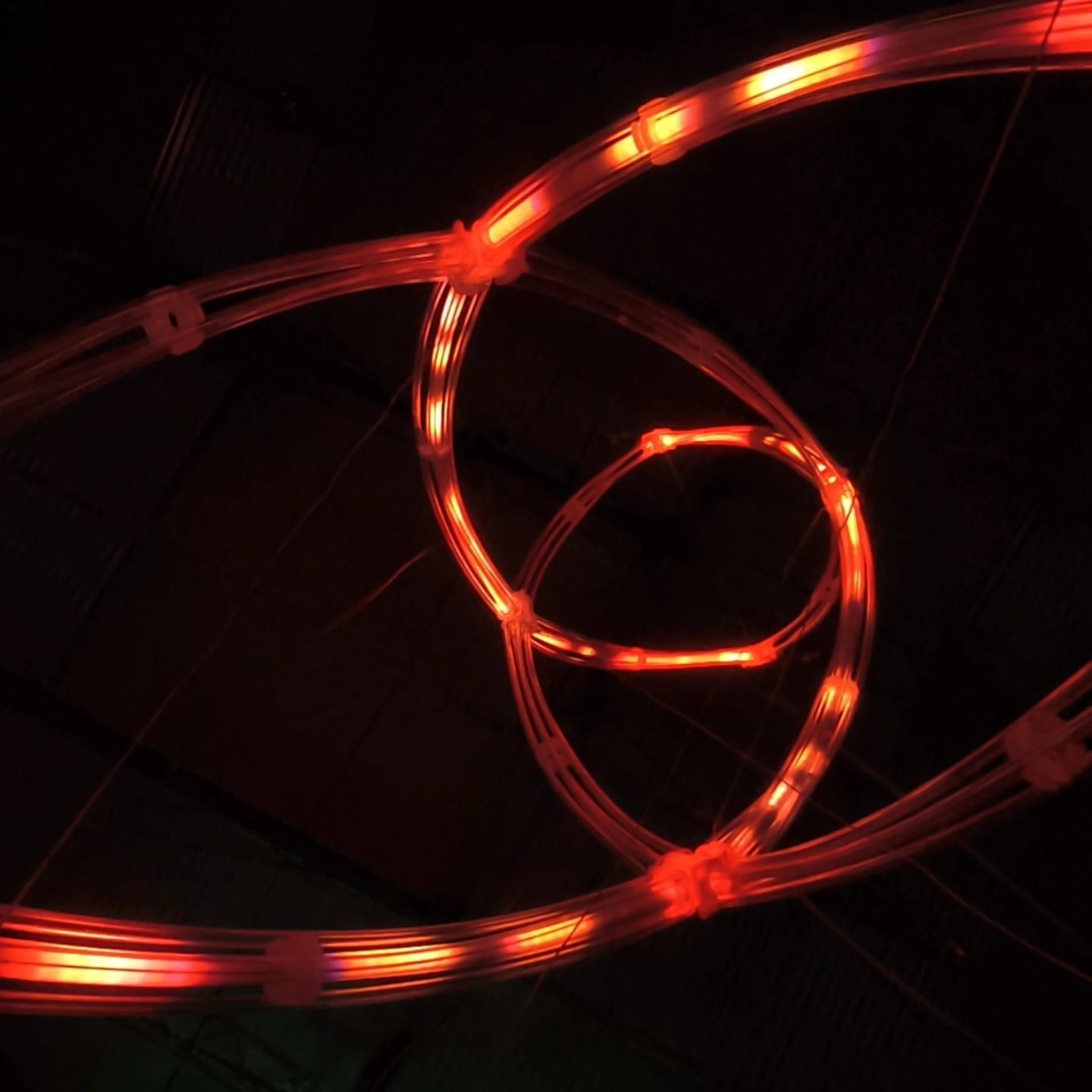
Plasma Filament explores light as a structural field rather than a contained object.
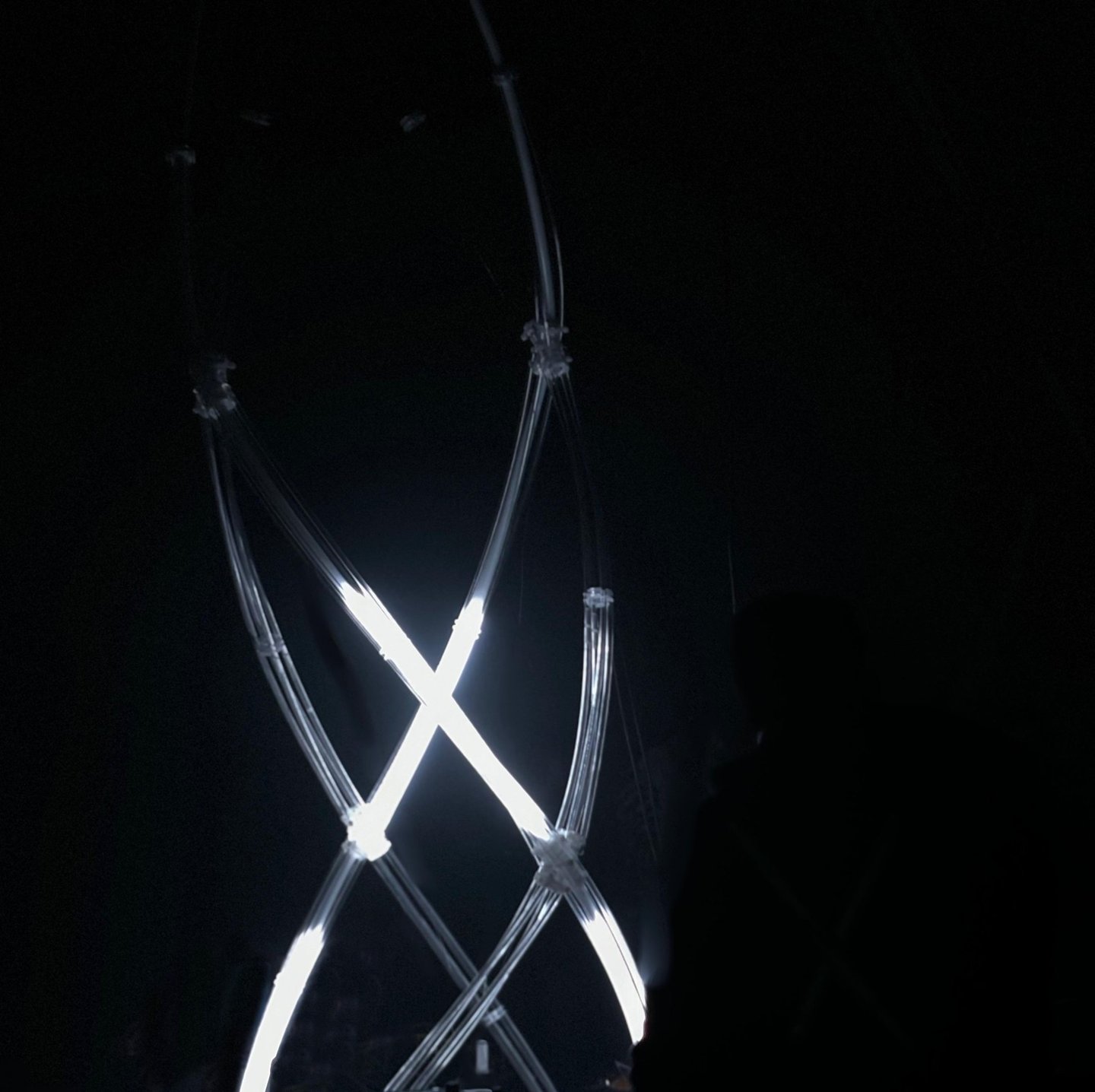
Developed as part of our ongoing research into nodal and tensile systems, the prototype investigates how luminous linear elements can intersect, bend, and generate volumetric presence through controlled tension.
Rather than composing a closed form, the system operates as an emergent spatial condition — density formed by intersections.
Research Focus
This study examines:
Flexible tubular light elements
Transparent nodal connectors
Tension-based structural curvature
Modular expansion potential
The intersections create zones of intensified luminosity, where lines overlap and energy concentrates. Structure and light become indistinguishable.
Constructive Logic
Continuous flexible LED tubes
Transparent polycarbonate nodal joints
Tension-driven arc formation
Modular radial expansion
The system allows:
Variable height and diameter
Repetition in vertical or radial arrays
Configurable density
Integration into immersive environments
Spatial Intention
Unlike chandelier typologies, Dark Matter proposes a distributed luminous framework.
The prototype demonstrates how intersecting arcs can produce a gravitational center without solid mass — a volumetric field defined by tension and crossing trajectories.
The system is scalable for:
Double-height hospitality spaces
Immersive installations
Performance or experiential environments
Large-scale suspended compositions
Status
Functional prototype completed.
Constructive system validated and ready for architectural scaling.